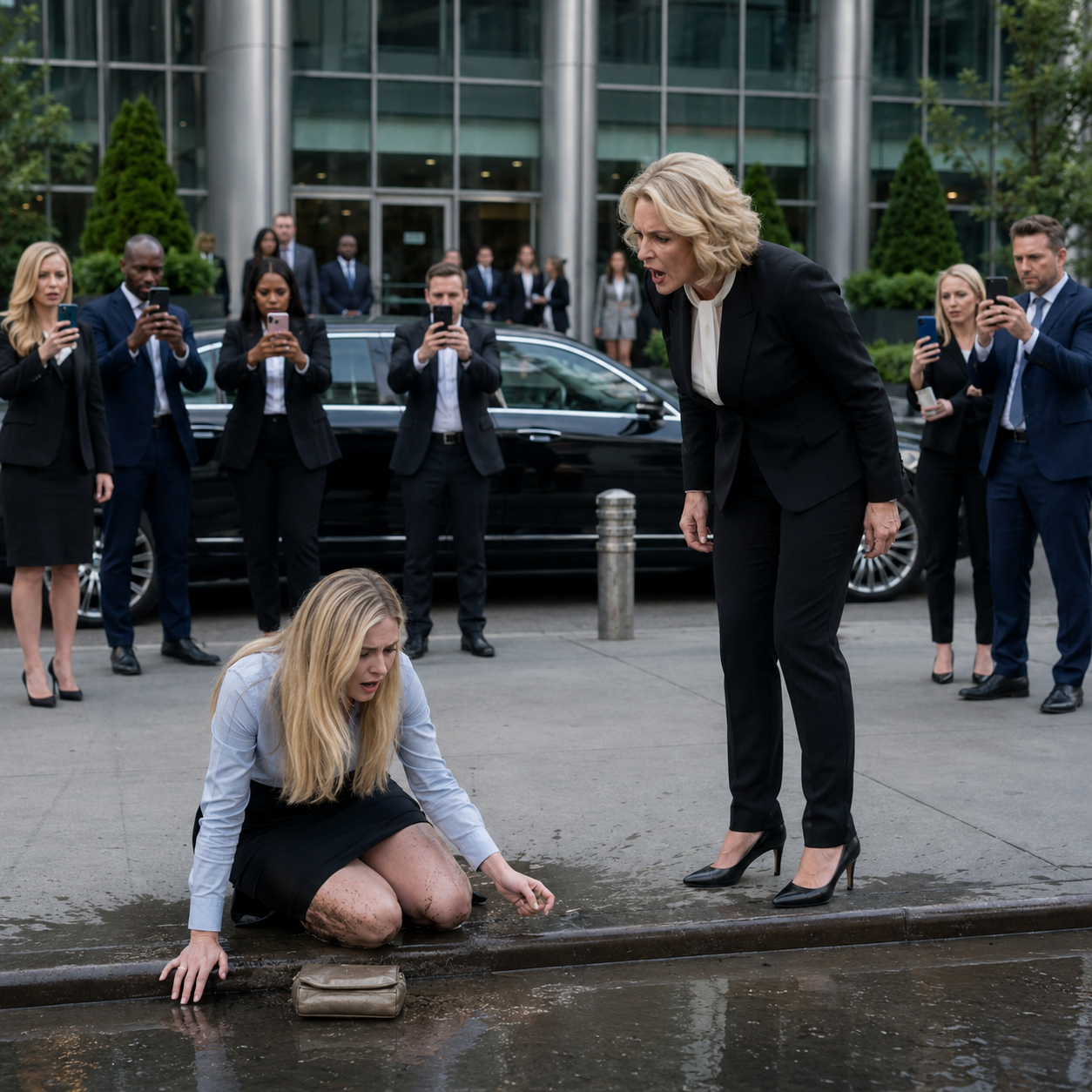
The man in the black suit removed a clean handkerchief from his pocket and gently offered it to her. She took it without lowering her eyes, wiping the dirty water from her cheek with slow, controlled movements. Around them, the crowd had gone completely silent. The phones that had been raised to record her humiliation now shook in uneasy hands. The wealthy mother stood only a few steps away, frozen in place, her face drained of confidence. She kept staring at the young woman as if the words she had just heard were impossible to accept.
A second car pulled up behind the black one, and two city officials stepped out quickly. One of them carried a dark coat and rushed toward the young office worker, placing it carefully around her shoulders. The gesture was respectful, almost protective, and it made the crowd understand that this was not a rumor, not a mistake, not some desperate trick. The woman in the puddle was not a powerless employee. She was someone whose silence had been mistaken for weakness, and whose dignity had survived every insult thrown at her.
The wealthy mother tried to recover, forcing a trembling smile. “I didn’t know,” she said, her voice breaking. “If I had known who she was…” The young woman looked at her calmly. “That is exactly why you should be ashamed,” she answered. “You only regret humiliating me because of my father. Not because what you did was wrong.” The crowd absorbed the words in heavy silence. Several people stopped recording and lowered their phones, suddenly embarrassed by their own curiosity.
Then the young man, the wealthy mother’s son, pushed through the crowd. He looked shocked, pale, and afraid as he saw the stained clothes, the red mark on her cheek, and his mother standing speechless in front of her. “What happened?” he asked, though the answer was already everywhere: on the phones, in the faces of the witnesses, in the dirty water still dripping from her skirt. The young woman looked at him with quiet disappointment. “Your mother showed me exactly what your family thinks of people without power,” she said. “And you showed me enough by not being here when it mattered.”
The man in the black suit opened the rear door of the luxury car, but she did not move immediately. She looked once more at the wealthy mother, not with hatred, but with a calm that felt even colder. “Tell your son he does not need to choose between us,” she said. “I already chose for him.” Then she turned and entered the car, leaving the entire sidewalk speechless. As the door closed, the wealthy mother reached out as if she wanted to stop her, but no words came. The car pulled away slowly, and the final image was her face reflected in the wet pavement: terrified, ruined, and finally aware that the woman she had pushed into the dirt had walked away with more power than she could ever buy.